





































Growth Engineering
Growth engineering means building marketing that keeps running after launch. We do it as AI revenue operations: former CROs get each process working first, then AI keeps it running alongside your team.
- indexed pages built
- 3,600+
- pipeline generated for clients
- $340M+
- to the first running process
- 3 wks
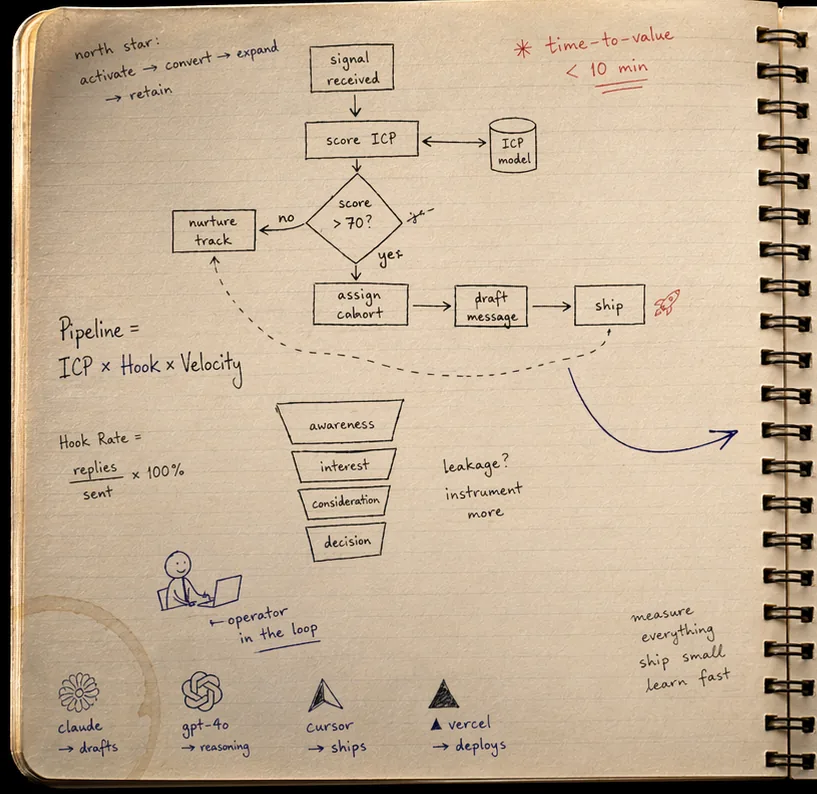
What we build
What we build.
Each one is set up and proven with our team, then runs every week on your stack. You own all of it.
- 01Learn What Works FirstFormer CROs and growth leaders study your buyers, your pipeline and your sales calls. The system gets built around what already produces for you.
- 02Proven First, Then AutomatedEvery process is proven before AI touches it. Then agents run it every week on your stack and your team approves what goes out.
- 03Measured in Your Own CRMEach process reports into the CRM your team already reads. When the numbers move, you see it there first.
- 04Runs Every WeekPages publish on a schedule. Outreach goes out every week. Reports build themselves while your team keeps the decisions.
The revenue system
Start with one process. Add more.
We learn the business and build your first go-to-market process on us this month.
Brings buyers to you.
Built once. Every process reads it.
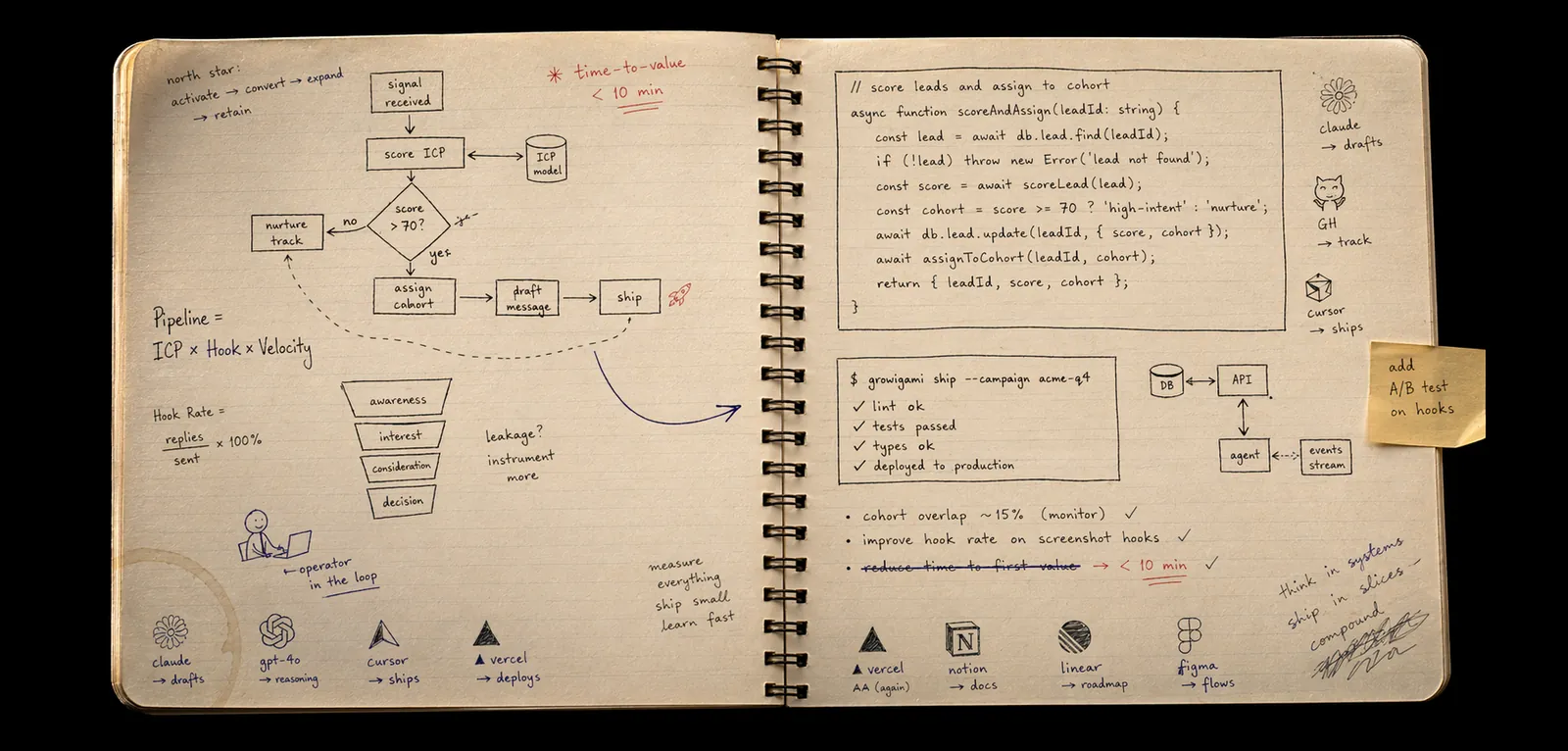
How it gets built
Proven first, then automated.
- Your CRM
- Sales calls
- First process
- Prove it works
- AI-run process
- Weekly review
- Slack Work to approve
- CRM Leads and replies
- Your site New pages
What runs every week
Your marketing, week by week.
- Monday We review last week's numbers with you.
- Tuesday New work is drafted for each running process.
- Wednesday Our team checks every draft before it ships.
- Thursday Work goes live on your site and in your inbox.
- Friday You get a short note on what shipped and what moved.
The Growth Engineering Thesis
There is a category of work that sits between marketing and engineering. It requires understanding both domains but belongs fully to neither.
This work includes building programmatic content systems that generate hundreds of pages from data. It includes constructing attribution pipelines that connect ad clicks to closed revenue. It includes automating outbound sequences that personalize at scale using real prospect data.
We call this growth engineering. At Growigami we run it as AI revenue operations. Former CROs prove each process works before it scales, then AI keeps it running.
Why Engineering Changes Growth
Traditional marketing teams are labor-constrained. Output scales linearly with headcount. Hire one writer, get four more articles per month. Hire one campaign manager, run two more channels.
Engineering breaks this linearity. A content template, once built, produces unlimited pages. A data pipeline, once connected, tracks every touchpoint automatically. An automation workflow, once deployed, runs 24/7 without fatigue.
The difference is not incremental. It is structural.
The Growth Engineering Stack
A complete growth engineering system has four layers:
Production layer - The systems that create marketing output. Content engines, ad generators, email sequence builders, landing page factories. These produce the volume.
Distribution layer - The infrastructure that gets output in front of the right people. Paid media management, outbound delivery, organic search optimization, social publishing. Automated where possible.
Measurement layer - Attribution pipelines, experiment tracking, conversion analytics. This is the nervous system that tells the rest of the machine what is working.
Optimization layer - Feedback loops that use measurement data to improve production and distribution. A/B test results refine templates. Attribution data shifts budget allocation. Conversion data improves targeting.
Each layer is built as software - code, configurations, and data schemas that run independently of any individual person.
The Compound Effect
Campaign-based marketing has a reset problem. Every quarter, the team starts over - new campaigns, new creative, new landing pages. Last quarter’s work is archived. Growth stalls.
Engineering-based growth compounds. Content published in month one ranks higher in month six. Attribution data from Q1 improves targeting in Q2. Automation workflows refined in January perform better in March.
This compounding is not theoretical. It is math. And it is the reason growth engineering outperforms campaign-based marketing on every timeline longer than 90 days.
Talk to sales. Give us read access to your CRM, and within a week we show you the first process we would build and what it would produce.
Proof

$250M+ pipeline for Reworld.
“Hundreds of millions in pipeline. 150+ meetings a month. They understand our product, our buyers, and our sales cycle.”
- pipeline
- $250M+
- conversion
- +24%
- new segments
- +26%

Price
From $1,999 a month.
We learn the business and build your first go-to-market process on us this month.

FAQ
Questions before you start
What is growth engineering?
Growth engineering treats marketing like software. You build it once and it keeps running, with pages that publish on a schedule and reports that build themselves. We do this as AI revenue operations, next to your team.
What is the difference between growth engineering and growth hacking?
Growth hacking chases quick wins with clever tactics. Growth engineering builds processes that keep producing after the first win. We start with the tactic that works for you, prove it, then turn it into an AI-run process.
What skills does a growth engineering team need?
Marketing judgment first, then the skills to automate it. Our growth leaders have led marketing and sales teams as CROs. They pick what to build, prove it works first, then hand the repeat work to AI on your stack.
Is growth engineering only for large companies?
Small teams gain the most. You can do everything, you just don't have the time. Each process starts at $1,999 a month, and your first process is built on us.

Start with one process.
We learn the business and build your first go-to-market process on us this month.