ABM Outbound Sequences That Actually Convert
Most SaaS outbound sequences are bad for the same reason: they are built as a series of asks rather than a progression of value.
The typical approach: send an intro email, follow up three days later with “just checking in,” try once more with “bumping this to the top of your inbox,” then give up. Three variations of the same message, all asking for the same meeting, with no reason for the prospect to say yes to the third email when they ignored the first.
Sequences that generate pipeline work differently. They treat the outbound touchpoint as one part of a multi-channel marketing system targeting multiple stakeholders. Each step earns attention before asking for action. The channel varies. The angle shifts. And the entire sequence is built on a segmentation framework that determines how much investment each account deserves.
ABM vs Demand Gen vs Outbound: What Actually Differs
Before building sequences, it helps to understand where ABM outbound sits relative to the other motions your team is probably running. These three approaches overlap in practice, but they differ in targeting philosophy, channel mix, and how long they take to produce pipeline.
| Dimension | Traditional Outbound | ABM | Demand Generation |
|---|---|---|---|
| Target | Wide list, any contact | Named accounts, buying committee | Market segment, inbound motion |
| Personalization | Template with merge fields | Account + persona + individual | Content-level, not contact-level |
| Channels | Email only | Email + LinkedIn + phone + mail | Content, ads, events, SEO |
| Measurement | Meetings booked, replies | Pipeline per account, multi-thread depth | MQLs, pipeline influenced |
| Best ACV | $5K-$30K | $30K+ | $5K-$100K+ |
| Time to pipeline | 2-4 weeks | 6-12 weeks | 3-6 months |
| Compounding | No (linear effort) | Moderate (relationships build) | Yes (content and brand compound) |
The short version: traditional outbound is fast but does not compound. Demand gen compounds but is slow. ABM sits in the middle — deeper investment per account than spray-and-pray outbound, faster to pipeline than waiting for inbound to mature.
As Brent Adamson, former Distinguished VP at Gartner and co-author of The Challenger Sale, has argued, the modern B2B buying journey is fundamentally non-linear. Buyers loop between problem identification, solution exploration, and requirements building in unpredictable patterns. ABM outbound sequences that account for this non-linearity — varying channels, angles, and stakeholders — align with how buying committees actually work, rather than how sellers wish they worked.
Most SaaS companies need at least two of these three motions running simultaneously. The question is which accounts get which treatment. For a deeper look at how demand gen and growth marketing differ in practice, we break that down separately. And if you are thinking about how these motions feed into each other across the full SaaS marketing funnel, that context is worth reading alongside this piece.
Segmentation Comes Before Sequences
Writing outbound copy before defining your segments is like building a house before surveying the land. The sequence structure, channel mix, personalization depth, and even the number of touchpoints should all be determined by the account tier.
The Three-Tier Framework
| Tier | Account Count | Investment per Account/Quarter | Channel Mix | Personalization Level |
|---|---|---|---|---|
| Tier 1 | 10-25 accounts | $500-$2,000 | Email + LinkedIn + direct mail + events + executive engagement | Individual (research each person) |
| Tier 2 | 50-150 accounts | $100-$500 | Email + LinkedIn + targeted ads | Account-level + persona-level |
| Tier 3 | 200-1,000 accounts | $25-$100 | Email + LinkedIn profile views | Persona-level templates with account variables |
The mistake most SaaS companies make: treating all accounts like Tier 3. Running the same generic sequence to 5,000 contacts and hoping volume compensates for relevance. This is the difference between demand generation and ABM: demand gen casts wide, ABM goes deep.
How to Assign Tiers
Score each target account on four dimensions:
- ICP fit (40% weight): Does this account match your ideal customer profile on firmographics, technographics, and use case?
- Intent signals (25%): Is this account showing research behavior? Are they visiting your site, engaging with competitors, searching relevant terms? (Tools like Bombora, 6sense, or G2 Buyer Intent surface these signals.)
- Relationship proximity (20%): Do you have a warm connection? Has anyone at the account interacted with your content, attended a webinar, or connected with your team on LinkedIn?
- Deal potential (15%): What is the realistic annual contract value if they become a customer? Knowing your SaaS startup metrics — average ACV, expansion rate, payback period — makes this scoring exercise much more precise.
Accounts scoring in the top 5-10% go into Tier 1. The next 15-20% are Tier 2. Everything else is Tier 3.
The Multi-Channel Sequence Architecture
A single-channel outbound sequence is a dial-up modem in a broadband world. B2B buying groups involve 6-10 decision makers according to Gartner research, and each person consumes four or five pieces of information independently before engaging with sales, per the same Gartner research. A SaaS outbound cadence that relies on email alone reaches one person through one channel.
The sequence architecture we run for SaaS clients uses 4 channels in a coordinated pattern.
Channel Roles
Email is the primary carrier of your value proposition. It delivers specific, relevant information directly. Email handles the “why this matters to you” message.
LinkedIn is for awareness and credibility. Profile views, content engagement, and connection requests build familiarity before and between email sends. LinkedIn handles the “I am a real person and here is why you should recognize my name” function.
Phone is for Tier 1 accounts and engaged prospects only. A well-timed call after 2-3 positive signals (email opens, LinkedIn acceptance, website visit) converts at a much higher rate than cold calls into a void.
Direct mail is the Tier 1 differentiator. A physical item (a relevant book, a handwritten note, a branded item tied to a specific message in the sequence) cuts through digital noise. Reserve this for the accounts worth the investment.
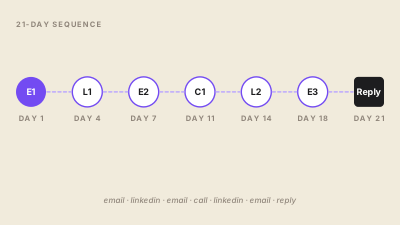
The 28-Day Tier 2 Sequence (Template)
This is the ABM email sequence framework we use most frequently for B2B SaaS clients targeting mid-market accounts. Adjust timing and touchpoints based on your sales cycle and ICP behavior. For a deeper look at the strategy layer behind these sequences, see our account-based marketing execution guide.
| Day | Channel | Purpose | Notes |
|---|---|---|---|
| 1 | Profile view | No message. Just visibility. | |
| 2 | Email 1 | Problem-aware opener | Lead with a challenge specific to their segment. No pitch. |
| 3 | Engage with their content | Like or comment on a recent post. Genuine, not performative. | |
| 5 | Connection request | Short, personalized note. No pitch in the request. | |
| 7 | Email 2 | Insight or framework | Share a relevant data point, framework, or perspective. Provide value. Still no meeting ask. |
| 10 | Share relevant content | Post or share something that would be genuinely useful to them. | |
| 12 | Email 3 | Case reference | Brief reference to a result with a similar company. Specific numbers. First soft CTA: “Worth a 15-minute conversation?“ |
| 16 | Email 4 | Different angle | Approach the problem from a different persona’s perspective (e.g., if previous emails focused on marketing, shift to a revenue or ops angle). |
| 20 | Direct message | Short message referencing a specific email you sent. Not a pitch. A check-in. | |
| 24 | Email 5 | Breakup or trigger-based | If no engagement: a clean, no-pressure close (“Not the right time? No problem. Here is something useful regardless.”) with a valuable resource attached. If engagement signals exist: a more direct meeting request. |
| 28 | Email 6 (optional) | Re-angle | Only send if there were open/click signals but no reply. New subject line, new angle entirely. |
The key principle: the first two emails provide value without asking for anything. The meeting ask comes after you have established relevance. This is the sequence equivalent of earning the right to pitch.
“We tested this against a front-loaded pitch sequence across three clients,” says Alexander Chua, co-founder of Growigami. “The value-first cadence had a 40% lower total reply rate but a 3x higher positive reply rate. The people who responded were actually interested, not just telling us to stop emailing them.”
Copy Principles That Drive Replies
Outbound copy is not marketing copy. It is a conversation starter. The rules are different.
The Three-Line Test
Every outbound email should be scannable in under 10 seconds. If the recipient cannot understand who you are, why you are reaching out, and what they should do next within three lines of visible text (before scrolling), the email fails.
What Works in 2026
Lead with the prospect’s world, not yours. The first sentence should reference something about their company, their role, or their industry. Never open with your company name or what you do.
One idea per email. Each email in the sequence tackles one angle. Do not cram three value propositions into a single message. Email 1 is about the problem. Email 2 is about an insight. Email 3 is about a result. Separate them.
Use specific numbers. “We helped a Series B fintech reduce CAC by 34% in one quarter” outperforms “We help companies improve their marketing efficiency.” Specificity creates credibility. If you need to calculate what these numbers mean for your business, use our CAC payback calculator.
Short paragraphs, short sentences. Two to three sentences per paragraph maximum. Most B2B emails are read on mobile during transitions between meetings. Respect that context.
Questions over statements. Ending an email with a question (“Is reducing churn rate a priority this quarter?”) gets more replies than ending with a statement (“Let me know if you would like to learn more.”). Questions create a social obligation to respond.
No jargon, no buzzwords. Corporate filler words and marketing speak signal that you are reading from a script. Write like you talk. If you would not say it in a real conversation, do not put it in an email.
Subject Lines
The subject line determines whether the email gets opened. Keep it under 40 characters. Make it specific to the recipient or their company. Avoid anything that looks like marketing.
Subject lines that work:
- “[Company name] + [your company name]”
- “Question about [specific initiative]”
- “[Mutual connection] suggested I reach out”
- “[Relevant metric] at [their company]”
Subject lines that do not work:
- “Quick question” (overused, feels manipulative)
- “Boost your [metric] by X%” (marketing, not conversation)
- Anything with emojis, all caps, or “RE:” when there was no prior conversation
Sample Email Copy by Sequence Step
Principles are useful. Seeing how they translate into actual opening lines is more useful. Below are template frameworks for each step of the 28-day sequence. These are angle templates, not copy-paste scripts — adapt the specifics to your ICP, your product, and the account you are targeting.
Email 1 — Problem-aware opener (Day 2):
“[First name], [company] is one of the few [industry] companies I have seen approaching [specific challenge] differently. Most teams in your space are still doing X while the market shifts toward Y.”
The goal of email 1 is recognition, not conversion. You are signaling that you understand their world well enough to notice what makes them different. No product mention. No CTA. Just a relevant observation that earns a mental bookmark.
Email 2 — Insight or framework (Day 7):
“Ran across something interesting this week. [Industry peer company] published their [relevant metric] — [X number]. For context, the benchmark for [their segment] is [Y]. Made me think about where [prospect company] falls.”
Email 2 provides something the recipient did not have before: a data point, a comparison, a framework they can use regardless of whether they ever talk to you. This is the “give before you ask” email. The insight should be genuinely useful, not a thinly disguised pitch.
Email 3 — Case reference (Day 12):
“Last quarter we worked with a [similar-stage, similar-industry] company facing [same challenge]. They went from [starting metric] to [ending metric] in [timeframe]. The approach: [one-sentence summary].”
This is where you earn the right to a soft CTA. The case reference should be specific enough to be credible (real numbers, real timeframe) but general enough that you are not disclosing client details. End with: “Worth a 15-minute conversation to see if something similar applies?”
Email 4 — Different angle (Day 16):
“Most of the [role] leaders I talk to are focused on [common priority]. But the ones generating outsized results are thinking about [adjacent problem] first. Here is why that sequence matters for [prospect company’s situation].”
Email 4 shifts the frame. If emails 1-3 spoke to the marketing leader about pipeline, email 4 might approach the same problem from a revenue operations or finance angle. The shift signals depth — you are not a one-trick vendor with a single talking point.
Email 5 — Clean breakup (Day 24):
“[First name], this is the last note on this. If [challenge] is not a priority right now, no pressure at all. Either way, here is [valuable resource] that might be useful regardless of timing.”
The breakup email works because it removes pressure. Attach something genuinely valuable — a benchmark report, a framework doc, a calculator. In our experience, breakup emails with a useful attachment generate replies at rates comparable to email 1, often from prospects who read every previous email but were not ready to engage.
A note on tone: every one of these templates reads like a peer writing to a peer. Not a sales rep executing a playbook. The moment your copy feels automated or performative, reply rates drop. Write each email as if you were sending it to one person, because in the recipient’s inbox, that is exactly what it is.
Multi-Threading: Reaching the Buying Committee
For B2B SaaS deals above $30K ACV, a single contact sequence is almost never enough. The buying committee typically includes 6-10 people across different functions.
The Multi-Thread Approach
Identify 3-5 stakeholders per target account. Map the likely buying committee: the economic buyer (usually VP or C-level), the technical evaluator, the end user champion, and the internal coach (someone who has interacted with your content or brand before).
Stagger the sequences. Do not email all five stakeholders on the same day. Start with the person most likely to respond (usually the end user champion or someone who has shown intent signals). Once you get a response or signal from one person, reference that engagement when reaching out to the others. LinkedIn touches are especially effective for multi-threading — profile views and content engagement make your name familiar before the email arrives. For more on how to use LinkedIn as a B2B channel, see our SaaS LinkedIn marketing guide.
Vary the message by persona. The CFO cares about cost reduction, ROI, and risk. The VP of Marketing cares about pipeline efficiency and marketing metrics. The end user cares about daily workflow improvement. Same product, different frame.
Use internal referrals. If one stakeholder responds positively, ask them who else should be part of the conversation. In our experience, internal referrals convert at significantly higher rates than cold outreach to the same account because the introduction carries internal credibility.
Multi-Thread Sequence Example (Tier 1)
| Week | Contact | Action |
|---|---|---|
| Week 1 | Champion (end user) | Full sequence starts. LinkedIn + email. |
| Week 2 | Economic buyer (VP/C-level) | Shorter, more direct sequence. Reference the champion’s engagement if applicable. |
| Week 2 | Technical evaluator | Sequence focused on integration, security, and technical architecture. |
| Week 3 | All contacts | If no response from any: direct mail piece to the economic buyer. |
| Week 4 | Internal coach (if identified) | Soft outreach asking for guidance on the right person to connect with. |
Deliverability: The Invisible Foundation
None of this matters if your emails land in spam. Deliverability is the infrastructure that makes outbound possible.
The Deliverability Checklist
- Dedicated outbound domains. Never send cold outbound from your primary company domain. Register 2-3 secondary domains (e.g., if your company is acme.com, use getacme.com or acmeteam.com) and set up proper DNS records.
- SPF, DKIM, and DMARC. All three must be configured on every sending domain. This is non-negotiable. Email providers check these records to determine if your email is legitimate.
- Domain warming. New domains need 2-4 weeks of gradual volume increase before running full sequences. Start with 5-10 emails per day and increase by 5-10 per day each week.
- Sending limits. Cap at 30-50 emails per domain per day for cold outbound. Exceeding this threshold triggers spam filters regardless of content quality.
- List hygiene. Verify every email address before sending. Bounce rates above 3% damage domain reputation. Use verification tools (NeverBounce, ZeroBounce, or Instantly’s built-in verification) before loading any list into your sequence tool.
- Inbox monitoring. Tools like GlockApps or Instantly’s deliverability dashboard show you whether emails are landing in primary inbox, promotions, or spam across major providers.
The Sending Infrastructure
For most SaaS companies running outbound, the setup looks like:
- 2-3 outbound domains with 2-3 email accounts each (6-9 sending accounts total)
- Each account sends 30-40 emails per day
- Total capacity: 180-360 outbound emails per day
- Sequences stagger across accounts to avoid pattern detection
This setup handles Tier 2 and Tier 3 volume for most early-to-mid-stage SaaS companies. If you need more volume, add domains rather than increasing per-account limits.
The ABM Outbound Tool Stack
The tools you pick matter less than whether you actually use them consistently. That said, the wrong stack creates friction that kills execution. Here is how the landscape breaks down by category, with realistic pricing as of early 2026.
| Category | Tool | Starting Price | Best For |
|---|---|---|---|
| Sales engagement | Apollo | $49/mo | Startups, combined data + sequencing |
| Sales engagement | Outreach | ~$100/user/mo | Mid-market, enterprise teams |
| Sales engagement | Salesloft | ~$75/user/mo | Teams with coaching needs |
| Sales engagement | Instantly | $30/mo | Cold email volume, deliverability focus |
| B2B data | ZoomInfo | $15K+/year | Enterprise, highest data coverage |
| B2B data | Apollo | $49/mo (included) | Budget-conscious, combined stack |
| B2B data | Lusha | $36/mo | Quick lookups, Chrome extension |
| Intent data | Bombora | Custom | Largest intent data co-op |
| Intent data | 6sense | Custom | Full ABM platform with orchestration |
| Intent data | G2 Buyer Intent | Custom | Category-level buyer signals |
| Email verification | NeverBounce | $0.003/email | Bulk verification |
| Email verification | ZeroBounce | $0.007/email | Higher accuracy, deliverability score |
| Deliverability | GlockApps | $59/mo | Inbox placement testing |
| Social | LinkedIn Sales Nav | $99/mo | Research, saved leads, InMail |
Minimum Viable Stack vs Full Stack
For early-stage SaaS companies running their first outbound motion, the minimum viable stack costs roughly $200/month: Apollo for data and basic sequencing, Instantly for dedicated cold email sending with built-in deliverability monitoring, and LinkedIn Sales Navigator for research and social touches. This combination covers all four channels in the sequence architecture above and gets you running within a week.
The full stack — ZoomInfo for data, Outreach or Salesloft for sequencing, 6sense or Bombora for intent signals, plus verification and deliverability tools — runs $3,000+/month before you factor in headcount to operate it. That investment makes sense when you are running multi-threaded Tier 1 campaigns across 50+ target accounts with a dedicated SDR team. It does not make sense when you have one rep testing outbound for the first time.
Start with the minimum viable stack. Graduate to the full stack when you have proven the motion works and the unit economics justify the spend. For a detailed breakdown of how these tools compare feature by feature, see our ABM tools comparison. And if you are trying to figure out how outbound tooling fits into your overall SaaS marketing budget, we cover that allocation math separately.
Measurement: What to Track and What to Ignore
Outbound metrics split into two categories: engagement metrics that tell you if the sequence is working, and pipeline metrics that tell you if it is worth doing.
Engagement Metrics (Weekly)
| Metric | Target | What It Tells You |
|---|---|---|
| Open rate | 45-65% | Subject line and deliverability health |
| Reply rate (total) | 15-25% | Message relevance and targeting quality |
| Positive reply rate | 5-12% | Conversion potential of the sequence |
| Bounce rate | Below 3% | List quality and verification effectiveness |
| Unsubscribe rate | Below 1% | Targeting accuracy (high = wrong audience) |
Pipeline Metrics (Monthly)
| Metric | What It Tells You |
|---|---|
| Meetings booked per 100 accounts contacted | Sequence efficiency (target: 3-8 meetings per 100 Tier 2 accounts) |
| Pipeline value generated from outbound | Revenue justification for the program |
| Accounts progressed from cold to engaged | Demand generation effectiveness |
| Multi-thread depth (avg. contacts engaged per account) | Account penetration quality |
| Cost per meeting booked | Unit economics of outbound vs. other channels |
What to Ignore
- Open rates in isolation. Apple Mail Privacy Protection inflates open rates. Use open rate trends over time, not absolute numbers.
- Total emails sent. Volume is a cost, not an achievement.
- Sequence completion rate. A prospect who replies on email 2 and books a meeting never sees emails 3-6. Low completion rate can be a good sign.
When Outbound Is Not the Right Channel
Outbound sequences are not universally applicable. They are one channel inside a broader SaaS marketing strategy, and choosing the wrong channel for your stage and ACV is a common way to burn budget. They underperform when:
- Your ACV is below $5K/year. Based on industry estimates, the cost per meeting from outbound typically runs $200-$500 depending on targeting quality and deal size. If your average deal is $3K, the unit economics do not work. Focus on inbound and product-led growth instead.
- You cannot clearly define your ICP. If you cannot describe your ideal customer in specific, firmographic terms, your targeting will be too broad and reply rates will suffer. Fix your positioning first.
- Your product requires a long education cycle. If the prospect needs to fundamentally change how they think about a problem before they can evaluate your solution, outbound alone will not get there. Pair it with content marketing and thought leadership. In these cases, an SEO-first playbook that builds organic awareness before outbound touches it is often the better starting point.
- Your deliverability infrastructure is not set up. Sending outbound from your primary domain without warming, verification, or proper DNS configuration will damage your domain reputation. Get the infrastructure right before launching sequences.
Building the Machine
Outbound sequences are a system, not a set-it-and-forget-it campaign. The companies that generate consistent pipeline from outbound treat it as an ongoing operation:
- Test one variable per sequence cycle (subject line, opening line, CTA, timing)
- Review reply quality, not just reply quantity
- Update targeting criteria quarterly based on closed-won analysis
- Rotate messaging angles as the market evolves
- Maintain deliverability infrastructure like you maintain production systems
The sequence itself is 20% of the work. The other 80% is segmentation, personalization research, deliverability management, and continuous iteration based on what the data tells you. Outbound is not a campaign you launch and measure once — it is a pipeline marketing discipline that compounds as your targeting sharpens and your domain reputation matures. For the email marketing fundamentals that underpin all of this, see our B2B SaaS email marketing guide. For a comparison of the tools mentioned in this piece, see our ABM tools comparison.
Get the sequence template. We built a free 28-day ABM sequence spreadsheet that maps every touchpoint, channel, and message angle from this article. Includes Tier 1, 2, and 3 variants plus a deliverability setup checklist. Download the ABM Sequence Template (no email required).
Frequently asked
How many touchpoints should an ABM outbound sequence have?
Effective B2B outbound sequences typically run 12-18 touchpoints across 3-4 channels over 28-45 days. Research from Gartner indicates that B2B buying groups involve 6-10 decision makers, each consuming 3-7 pieces of content independently before engaging with sales. A single-channel, 5-email sequence is not enough to reach multiple stakeholders and build enough familiarity to earn a response. The key is varying the channel and message angle at each step, not repeating the same ask louder.
What reply rate should SaaS outbound sequences target?
For cold outbound to well-segmented B2B SaaS accounts, target a 5-12% positive reply rate. Total reply rates (including objections and not-interested responses) typically run 15-25% for well-built sequences. Below 3% positive reply rate, the issue is usually targeting or messaging, not volume. Above 15%, the segment is warm and you should consider a faster, more direct cadence. These benchmarks assume proper email deliverability (domain warming, SPF/DKIM/DMARC, sending under 50 emails per domain per day from dedicated outbound domains).
Should ABM outbound sequences include LinkedIn touchpoints?
Yes. Multi-channel sequences that include LinkedIn outperform email-only sequences by a significant margin for B2B SaaS. LinkedIn touchpoints work best as awareness and credibility builders (profile views, post engagement, connection requests with no pitch) placed before and between email sends. The sequence pattern that consistently performs: LinkedIn profile view on day 1, email on day 2, LinkedIn connection request on day 5, email follow-up on day 7. LinkedIn InMail has a lower response rate than regular connection messages for cold outreach, so save InMail budget for re-engagement of warm accounts.
How do you personalize ABM outbound at scale?
Personalization operates at three levels. Account-level: reference the company's industry, recent news, funding round, or a specific challenge common to their segment. Persona-level: tailor the value proposition to the recipient's role (a CFO cares about cost reduction and ROI, a VP of Marketing cares about pipeline efficiency). Individual-level: reference something specific to the person (a LinkedIn post they wrote, a conference they spoke at, a podcast appearance). For Tier 1 accounts, invest in individual-level personalization. For Tier 2 and 3, account-level and persona-level personalization is sufficient and scalable.
What is the best day and time to send B2B outbound emails?
For B2B SaaS, Tuesday through Thursday between 8-10 AM in the recipient's local time zone consistently delivers the highest open rates. Monday mornings are crowded with internal emails and weekend catch-up. Friday afternoons get buried. However, timing matters less than relevance and deliverability. A well-personalized email sent at 2 PM on a Wednesday will outperform a generic template sent at the 'optimal' 9 AM Tuesday. Focus on message quality and deliverability infrastructure first, then optimize send times as a secondary lever.
How do you handle prospects who do not respond to the full sequence?
Prospects who complete a full sequence without responding go into a nurture hold for 60-90 days, then re-enter a shorter re-engagement sequence (3-5 touches) with a completely different angle. Do not re-run the same sequence. The re-engagement sequence should reference a new trigger: a product update, a relevant industry report, a case study from a similar company, or a change in their business (new funding, leadership change, expansion). After two full cycles with no response, move the account to a long-term marketing nurture (newsletter, retargeting) rather than continuing direct outbound.
What tools do you need to run ABM outbound sequences?
The minimum viable stack: a sales engagement platform for sequence automation (Apollo, Outreach, Salesloft, or Instantly), a B2B data provider for contact information (Apollo, ZoomInfo, or Lusha), LinkedIn Sales Navigator for research and social touches, and a CRM (HubSpot or Salesforce) for pipeline tracking. For intent data, tools like Bombora, 6sense, or G2 Buyer Intent provide signals on which accounts are actively researching your category. Total cost for a functional outbound stack ranges from $200/month (Apollo + Instantly) to $3,000+/month (ZoomInfo + Outreach + 6sense) depending on scale.