





































SaaS Content Marketing Agency
A content calendar is a list. We build content engines: topic clusters and programmatic templates, set up and tested first, then run by AI so pages publish every week.
- indexed pages built
- 3,600+
- pipeline generated for clients
- $340M+
- to the first running process
- 3 wks

What we build
What we build.
Each one is set up and proven with our team, then runs every week on your stack. You own all of it.
- 01Content Engine ArchitectureWe build templated content systems that produce comparison pages, glossary terms, industry pages, and geo-specific landing pages from structured data. Volume with quality.
- 02Topic Cluster StrategyKeyword research mapped to buyer intent. Pillar pages anchor clusters. Supporting content fills gaps. Internal linking distributes authority. Every page has a role.
- 03AI-Assisted ProductionAI handles research, outlines, and first drafts. Human editors refine for voice, accuracy, and SaaS expertise. This delivers quality at speed.
- 04Performance-Driven ContentEvery piece has a goal, from ranking to pipeline. We track it and fix what lags before we publish more.
How it gets built
Proven first, then automated.
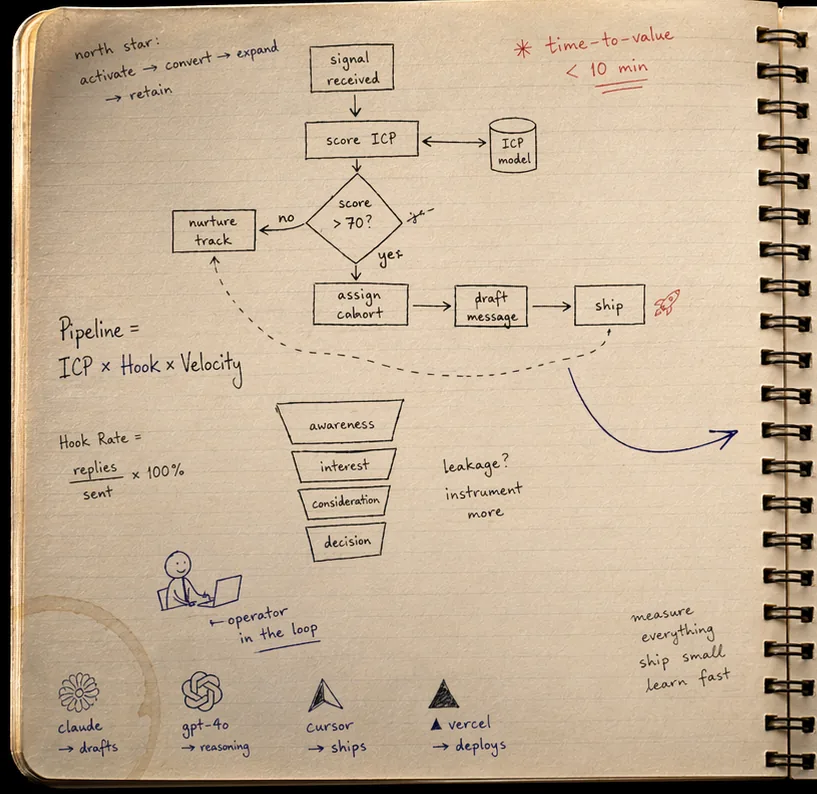
- Sales calls and support tickets
- Topic map
- Expert interview
- Draft
- Review
- Published page
- Your site New and refreshed pages
- Slack Drafts to approve
- Search Console Rankings and clicks
What runs every week
Search, week by week.
- Monday We pick the week's topics from search data and buyer questions.
- Tuesday Your expert answers a few questions on a short call.
- Wednesday Drafts are written and checked for facts and voice.
- Thursday Pages go live, with links from older pages.
- Friday We check rankings and AI citations, then refresh pages that slipped.
Content at Engine Speed
SaaS content marketing has a volume problem. Your competitors with mature content programs have thousands of indexed pages. Your agency is shipping four blog posts per month. At that rate, you are losing ground every week.
Growigami builds content engines. Former CROs pick the topics that match how your buyers search. We set up the templates and test the first pages, then AI keeps the engine publishing.
How Content Engines Work
Layer 1: Programmatic content - We build templates for repeatable content types. A comparison page template can generate 50 “Product A vs Product B” pages from a data set. A geo template can generate landing pages for every target city. This is engineering, not writing.
Layer 2: Pillar content - Long-form, authoritative articles that anchor topic clusters. These are written by SaaS marketers who understand the domain, not freelancers who learned it yesterday.
Layer 3: Supporting content - Blog posts, how-to guides, and data pieces that link back to pillars and fill keyword gaps in the cluster.
All three layers deploy simultaneously. You do not wait for pillar content to rank before launching programmatic pages. The system ships together.
Why AI Changes the Content Math
Traditional content production is constrained by writer capacity. One writer produces 4-8 quality articles per month. Hiring more writers adds management overhead and consistency risk.
AI changes this. Research, outlining, and first-draft generation happen in minutes, not days. Human editors focus on what they do best: voice, accuracy, and strategic framing. The result is high-quality content at 5-10x the speed.
Content Performance, Not Just Content Production
Publishing is the beginning, not the end. We track every page for:
- Ranking position and trajectory
- Organic traffic and click-through rate
- Conversion rate (to demo, lead magnet, or email capture)
- Pipeline attribution (did this content touch a closed deal?)
Underperformers get updated. Overperformers get expanded. Content is an asset that compounds - but only if you manage it like one.
Talk to sales. Give us read access to your CRM, and within a week we show you the first process we would build and what it would produce.
Real outputs
Our own site runs on this process.
SEO & Content
Generative Engine Optimization (GEO)
The practice of optimizing content to be surfaced and cited by AI-powered search engines and large language models like ChatGPT, Perplexity, and Google AI Overviews. The emerging discipline alongside traditional SEO.
B2B SaaS SEO in the Age of AI: What Still Works, What's Dead, and What's Next
SaaS SEO Cluster Mapping Template
- Tab 1Seed Keywords
- Tab 2Keyword Expansion
- Tab 3Cluster Groups
- Tab 4Prioritization Scoring
- Tab 5Content Map
Proof
“They built our launch motion. Outbound, content, paid - all running before our first sales hire.”
Across our clients
- indexed pages built
- 3,600+

Price
From $1,999 a month.
We learn the business and build your first go-to-market process on us this month.

FAQ
Questions about Search
What is a SaaS content marketing agency?
A SaaS content marketing agency produces content specifically for software companies - blog posts, pillar pages, comparison content, documentation, and landing pages designed for SaaS buyer journeys. Growigami adds programmatic content engineering to this, shipping at 10x traditional agency volume.
How much content can Growigami produce per month?
Programmatic content (comparisons, glossary, geo, industry pages) can ship 50-100 pages per month. Original long-form content (pillar pages, blog posts) typically ships 8-15 per month. Most clients run both simultaneously for maximum coverage.
Do you use AI to write content?
AI assists in research, outlining, and first drafts. Human editors with SaaS expertise review every piece for accuracy, voice, and quality. AI handles the 80% that is structural; humans handle the 20% that requires judgment and expertise.
How do you maintain content quality at high volume?
Three mechanisms: templated structures ensure consistency, editorial review catches errors, and performance tracking identifies underperformers for update. We also use a 23-point quality audit checklist on every piece before it publishes.

Start with one process.
We learn the business and build your first go-to-market process on us this month.