






























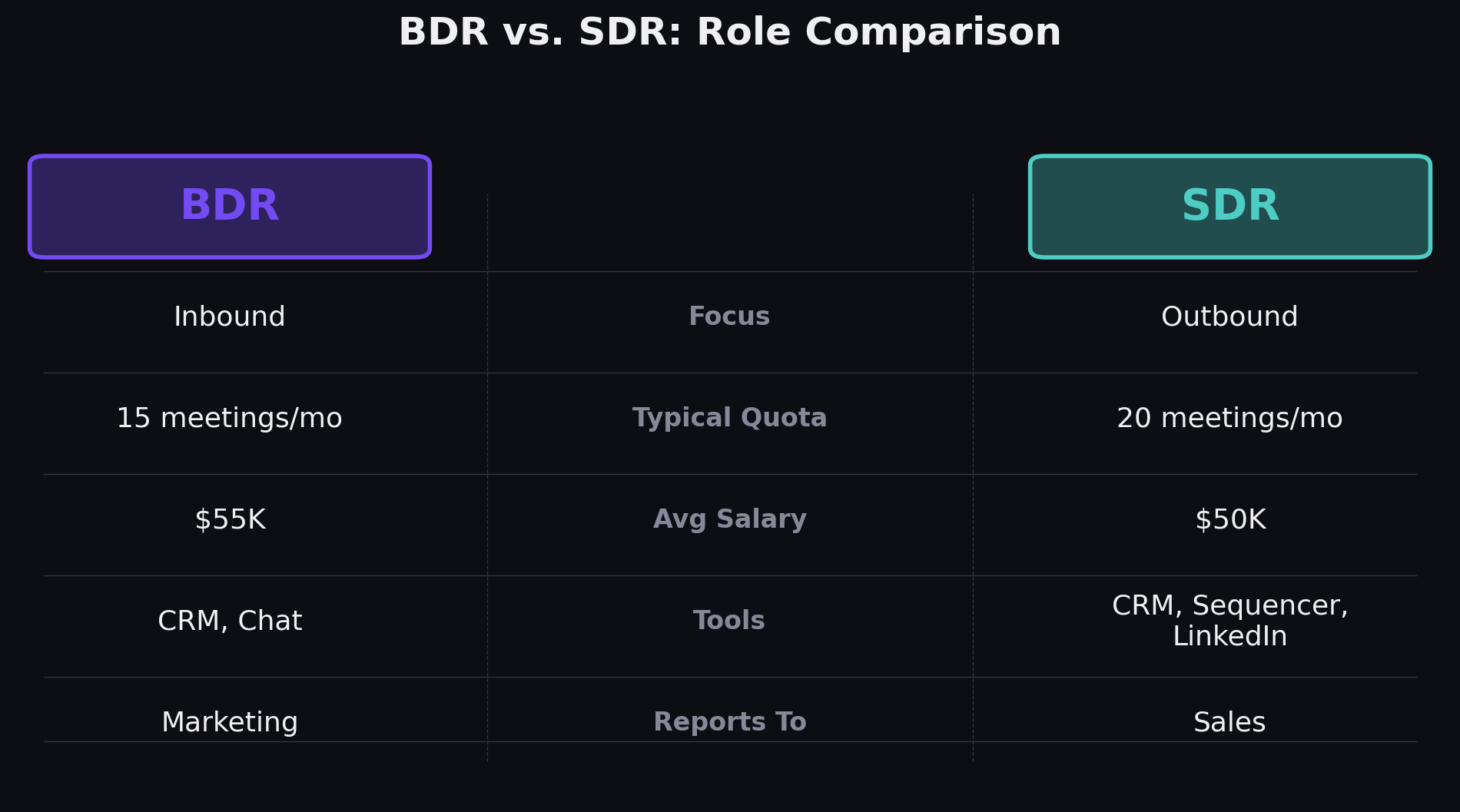
The difference between a BDR and an SDR is where the leads come from. An SDR (Sales Development Representative) works inbound leads: people who requested a demo, started a trial or downloaded content. A BDR (Business Development Representative) works outbound: target accounts that have not raised their hand. Both qualify prospects and book meetings for account executives (AEs), and neither closes deals.
Many companies use the two titles for the same job. The Bridge Group, which has studied sales development since 2007, surveys SDRs, BDRs and ADRs as one group. So when you read a job listing or plan a hire, ask one question: does this rep work leads that come in, or build pipeline from accounts that never asked? The answer tells you which role it is.
For either title on its own, see our SDR meaning guide and our BDR meaning guide.
The Core Difference: Inbound vs. Outbound
The distinction comes down to who starts the conversation:
- SDR (Sales Development Representative): Handles inbound leads. A prospect fills out a demo request, downloads a whitepaper, or attends a webinar. The SDR follows up, qualifies the lead, and books a meeting with an AE.
- BDR (Business Development Representative): Creates outbound pipeline. No one has raised their hand. The BDR identifies target accounts, researches contacts, and initiates conversations through cold email, cold calls, LinkedIn, and multi-channel sequences.
SDRs are reactive. BDRs are proactive.
That’s the canonical distinction. In practice, companies use these titles however they want - some swap them entirely, some call both roles “SDR,” some use “ADR” (Account Development Representative) as an umbrella term. This guide uses the industry-standard definitions above.
Why the Distinction Matters
The titles carry real differences. The skills, mindset, compensation, KPIs, tools, and management approach for each role are materially different.
An SDR who’s great at qualifying warm leads can struggle when asked to cold call CFOs. A BDR who thrives on the hunt can get bored processing inbound demo requests. Hiring the wrong profile for the wrong motion is the single most common mistake SaaS sales leaders make when building pipeline teams.
SDR vs BDR: Side-by-Side Comparison
| Dimension | SDR (Inbound) | BDR (Outbound) |
|---|---|---|
| Primary function | Qualify inbound leads, book meetings | Prospect outbound, generate pipeline |
| Lead source | Marketing-generated (MQLs) | Self-sourced or target account lists |
| First contact | Prospect initiated contact | Rep initiates contact |
| Core skills | Speed to lead, qualification, rapport | Research, persistence, personalization |
| Main channels | Phone and email follow-up on fresh leads | Cold email, cold calls and LinkedIn |
| Rejection rate | Lower (warm leads) | Higher (cold outreach) |
| Ramp time | 3.0 months average for the combined group | Same benchmark; outbound also needs lists and tested messaging first |
| Median pay | $80K OTE ($55K base, $25K variable) for the combined group | Same benchmark; no published data splits the titles |
| Closes deals? | No | No |
| Key metric | Lead-to-meeting conversion rate | Meetings booked from outbound |
| Average tenure | 1.9 years for the combined group | Same benchmark |
| Reports to | Sales manager or VP Sales | Sales manager or VP Sales |
| Career path | AE → Enterprise AE → Sales Manager | AE → Enterprise AE → Sales Manager |
| Personality profile | Organized, responsive, empathetic | Resilient, creative, competitive |
Pay, ramp and tenure figures: Bridge Group, SDR Models, Motions & Metrics 2025, which surveys SDRs, BDRs and ADRs as one group.
When to Hire an SDR vs a BDR
Hire an SDR first when inbound demand outruns your AEs. Hire a BDR first when you need pipeline that inbound will not bring. The signals for each:
Hire an SDR First When:
- Your inbound lead volume exceeds what AEs can handle (typically 100+ MQLs/month)
- Your AEs are spending more than 30% of their time on lead qualification instead of closing
- You have a working content/paid engine driving consistent demand
- Your ACV is under $25K and volume matters more than strategic account penetration
- You need pipeline from demand that already exists, without building lists first
Hire a BDR First When:
- Inbound lead flow is inconsistent or insufficient for your growth targets
- You’re entering a new market segment where no one knows you yet
- Your ACV is $25K+ and you need to target specific accounts
- Your ICP is narrow enough that you can build a named account list
- You need to create demand as well as capture it
- Your competitors are outbound-heavy and you’re losing deals you never knew existed
Hire Both When:
- You’re at $5M+ ARR with both inbound and outbound motions running
- You have the management capacity (one SDR/BDR manager per 6-8 reps)
- Your marketing team is generating enough inbound to keep SDRs busy AND you have a defined outbound ICP
- You can afford to invest in proper enablement, tooling, and comp plans for both teams
Don’t Hire Either Yet When:
- You don’t have product-market fit
- Your founders haven’t personally sold the product
- You can’t articulate your ICP in specific, measurable terms
- You don’t have the tooling (CRM, sequencing tool, call platform)
- You don’t have someone to manage them
Day in the Life: SDR
Here’s what a good SDR’s day actually looks like - not the idealized version from a sales enablement deck.
7:45 AM - Check the queue. Review overnight inbound leads. Demo requests get prioritized. Content downloads get scored. Lead interest fades fast, so the first reply goes out within minutes.
8:00 AM - Speed-to-lead blitz. Call and email every hot lead from the last 12 hours. The goal is a conversation, not a pitch. “Hey, saw you checked out our pricing page - what prompted you to look?” Short, direct, human.
9:30 AM - Qualification calls. Back-to-back calls with leads who responded to initial outreach. The SDR is running BANT (Budget, Authority, Need, Timeline) or MEDDIC - whatever framework the team uses - to determine if this lead is worth an AE’s time.
11:00 AM - CRM hygiene and handoffs. Log every conversation. Update lead statuses. Create meeting briefs for AEs: who the prospect is, what they care about, what objections came up, and what they’ve already seen (downloaded assets, pages visited, email engagement).
12:00 PM - Team standup. Quick sync with the SDR team and sales manager. Pipeline review. Share what’s working and what’s not. Celebrate wins.
1:00 PM - Follow-up sequences. Work through leads who didn’t answer the first call. Send follow-up emails. Engage leads on LinkedIn who opened emails but didn’t reply. The multi-touch sequence is where most pipeline actually gets built - it’s rarely the first touch.
3:00 PM - Nurture and re-engage. Go through aged leads that marketing has re-engaged. Check for buying signals: repeat website visits, new content downloads, pricing page views. Sometimes a lead that was a “no” three months ago is suddenly a “yes” because their budget cycle reset.
4:30 PM - Prep for tomorrow. Review tomorrow’s inbound queue. Check marketing calendar for upcoming campaigns that will drive leads. Block time for high-priority follow-ups.
Day in the Life: BDR
A BDR’s day looks fundamentally different. There’s no queue of warm leads waiting. The BDR has to manufacture their own pipeline from cold contacts. For a deeper look at how outbound fits into the broader B2B SaaS lead generation playbook, see our channel-by-channel guide.
7:30 AM - Account research block. The BDR reviews their target account list. They’re looking for trigger events: funding announcements, new executive hires, product launches, company expansions, earnings calls with relevant pain points. This research is what separates a good BDR from a spam cannon.
8:30 AM - Cold calling block #1. This is the highest-energy time of day. The BDR makes 30-40 calls in 90 minutes. Most go to voicemail. That’s fine - voicemails are touchpoints. The goal is 3-5 live conversations. Of those, 1-2 agree to a meeting on a good day.
10:00 AM - Personalized email outreach. Write and send 20-30 personalized cold emails. Not “Hi [First Name], I noticed your company…” templates. Real personalization: referencing a specific initiative, a LinkedIn post, a podcast appearance, a job posting that signals a pain point.
11:30 AM - LinkedIn engagement. Comment on target prospects’ posts. Send connection requests with short, non-pitchy notes. Share relevant content. The BDR is building familiarity so that when the cold email or call comes, the prospect recognizes the name.
12:30 PM - Lunch and learning. Good BDR teams spend part of lunch listening to call recordings, sharing successful scripts, or studying the product. The best BDRs are obsessively curious about the product they sell and the problems it solves.
1:30 PM - Cold calling block #2. Another 30-40 calls. Different time zones, different personas. Some BDRs prefer the afternoon for reaching West Coast prospects or senior executives who check voicemails after their meetings clear.
3:00 PM - Sequence management. Review automated sequences. Check open rates and reply rates. A/B test subject lines. Remove bounced contacts. Add new prospects. Adjust messaging based on what’s converting.
4:00 PM - AE collaboration. Meet with assigned AEs to discuss target accounts. The BDR brings intelligence: “I talked to someone at Acme who mentioned they’re evaluating three vendors this quarter.” The AE provides context: “Here’s how to position against those specific competitors.” This collaboration is where outbound goes from activity to strategy.
5:00 PM - Pipeline tracking and planning. Update CRM. Log every activity. Review tomorrow’s call list. Set intentions for the next day.
SDR vs BDR Salary: What the Data Shows
No published benchmark we could find gives separate pay figures for SDRs and BDRs. The two sources worth using treat sales development as one job:
| Source (date) | What it measures | Figure |
|---|---|---|
| Bridge Group 2025 SDR study (published Feb 2025) | Survey of 351 B2B companies, SDRs, BDRs and ADRs together | Median OTE $80K: $55K base, $25K variable (68:32). Unchanged since 2022 |
| Levels.fyi, Sales Development Representative (updated Nov 2, 2026) | Self-reported pay, skewed toward larger tech companies | Median total comp $90K; 25th percentile $73K; 75th $110K; 90th $135K |
OTE assumes 100% of quota, and only 60% of sales development reps reached quota in the Bridge Group’s 2025 data, so many take home less than their OTE. Company size, deal size and location move pay more than the title on the offer letter.
For base, benefits, ramp and the year-one cost of a seat, see our SDR salary guide or run your own numbers in the SDR cost calculator.
KPI Benchmarks: What Good Looks Like
Tracking the wrong metrics is almost worse than tracking nothing. Here’s what to measure for each role, with benchmarks based on B2B SaaS companies in the $2M-$50M ARR range.
SDR KPIs
| Metric | Target | Top Performer |
|---|---|---|
| Speed to lead (first response) | < 5 minutes | < 2 minutes |
| Inbound leads worked per day | 40-60 | 70+ |
| Lead-to-conversation rate | 25-35% | 40%+ |
| Conversation-to-meeting rate | 30-40% | 50%+ |
| Meetings booked per week | 8-12 | 15+ |
| Meeting show rate | 80%+ | 90%+ |
| SQL acceptance rate (AE accepts) | 70%+ | 85%+ |
| Pipeline generated per month | $150K-$300K | $400K+ |
BDR KPIs
| Metric | Target | Top Performer |
|---|---|---|
| Accounts researched per day | 10-15 | 20+ |
| Outbound touches per day | 60-100 | 120+ |
| Cold calls per day | 40-60 | 80+ |
| Personalized emails per day | 20-30 | 40+ |
| Connect rate (calls) | 5-8% | 12%+ |
| Reply rate (email) | 3-5% | 8%+ |
| Meetings booked per week | 4-6 | 10+ |
| Meeting show rate | 70%+ | 85%+ |
| Pipeline generated per month | $100K-$250K | $400K+ |
The metric that matters most: Pipeline generated. Not activities. Not calls made. Not emails sent. Pipeline. Everything else is a leading indicator. For a complete framework on which B2B SaaS marketing metrics to track, see our measurement guide. If a BDR books 10 meetings a week but none of them convert to pipeline, you have a targeting problem, not a performance problem.
The KPI targets above are our working ranges, not a published benchmark. For a published reference point, the Bridge Group’s 2025 study puts the median monthly quota at 10 meetings held and raw pipeline at $3.78M per rep per year.
Growigami Take: The most overlooked SDR/BDR metric is pipeline quality, not pipeline volume. Companies that track SQL acceptance rate and opportunity-to-close rate by rep, as well as meetings booked, build dramatically better teams because they can diagnose whether the problem is targeting, messaging, or qualification.
Outreach Templates That Actually Work
I’m including these because every “BDR vs SDR” article tells you outreach matters but none of them show you what it looks like. These are templates we’ve actually used and iterated on across multiple SaaS companies.
Cold Email Template (BDR - Outbound)
Subject: [Prospect’s company] + [specific pain point]
Hi [First Name],
Saw that [Company] just [trigger event - new funding round, new VP hire, product launch, job posting for specific role]. Usually when [type of company] hits that stage, [specific pain point] becomes the bottleneck.
We help [similar companies] [specific outcome with number]. [One-sentence proof point or social proof.]
Worth a 15-minute call this week to see if it’s relevant?
[Signature]
Why it works: Trigger event proves you did research. Pain point shows you understand their world. Specific outcome gives them a reason to care. The ask is small (15 minutes) and conditional (“if it’s relevant”).
What to avoid: “I hope this email finds you well.” “I’d love to pick your brain.” “We’re the leading platform for…” These get deleted before the second sentence.
Cold Call Opener (BDR - Outbound)
“Hey [First Name], this is [Your Name] from [Company]. I know I’m calling out of the blue - do you have 30 seconds?”
[If yes]: “I work with [similar companies/titles] who are dealing with [specific problem]. We’ve helped them [specific result]. I’m not sure if that’s relevant to you, but I figured it was worth a quick call to find out. Does [Tuesday/Thursday] work for 15 minutes?”
[If no/bad timing]: “Totally fair. When’s a better time to reach you this week? I’ll keep it to five minutes.”
Why it works: Acknowledges the interruption. Doesn’t pretend to be anything other than a cold call. Gives the prospect an out. Uses specificity to earn attention.
Inbound Follow-Up (SDR - Inbound)
Subject: Re: Your [resource they downloaded / demo they requested]
Hi [First Name],
You [downloaded our guide on X / requested a demo / attended our webinar on Y] - nice. I pulled up [Company] and it looks like you’re [observation about their business or situation].
Quick question: are you actively looking to [solve the problem your product addresses], or were you just doing some research?
Either way, happy to help. I can [offer something of value: share a case study from a similar company, walk you through how it works, connect you with a customer in your space].
What works for a quick call?
[Signature]
Why it works: References the specific action they took. Shows you looked at their company. The qualification question (“actively looking or just researching?”) is disarming - it gives the prospect permission to be honest, which actually increases meeting rates.
What Doesn’t Work
Let’s talk about the common mistakes that burn cash and demoralize teams. I’ve seen every one of these firsthand.
1. Hiring BDRs Before You Have Messaging
If your AEs can’t articulate the value proposition in a compelling way, your BDRs won’t magically figure it out. BDR outreach only works when the messaging resonates. If you’re still iterating on ICP and positioning, don’t hire a BDR team - hire a marketing partner to nail the messaging first, then arm the BDRs with it.
2. The “Hybrid” SDR/BDR Role
“We need someone who handles inbound AND does outbound prospecting.” This sounds efficient. It’s not. Inbound follow-up is urgent and reactive - a hot lead can’t wait. Outbound prospecting requires focused, uninterrupted blocks of time. When you combine both, the inbound always wins because it feels more urgent, and outbound gets neglected. You end up with an expensive SDR who never does outbound.
3. Activity-Based Management
Mandating 100 calls per day sounds tough and metrics-driven. It actually incentivizes bad behavior: speed-dialing through lists without research, leaving generic voicemails, burning through your TAM. The BDR hits their activity number but books zero meetings. Measure pipeline, not dials.
4. No Career Path
Average tenure for sales development reps is 1.9 years, and only 16% were promoted in 2024, down from 34% in 2020 (Bridge Group, 2025). Many leave because the company offers no clear promotion path. If your reps don’t see a roadmap to AE within 12-18 months, they’ll leave for a company that offers one.
5. Hiring Senior When You Need Junior (and Vice Versa)
A 10-year enterprise sales veteran will be miserable making 50 cold calls a day. A fresh college grad won’t know how to research accounts or navigate enterprise org charts. Match the experience level to the motion.
6. Ignoring Enablement
Handing a new BDR a list of accounts and saying “go book meetings” is not enablement. They need: competitive battle cards, ICP documentation, call scripts, email templates, objection handling guides, product demos they can reference, and recorded calls from top performers. The first 30 days of a BDR’s tenure should be 50% enablement, 50% execution.
Career Progression Paths
One of the most overlooked aspects of SDR/BDR hiring is where these people go next. If you can’t answer “what happens after 18 months in this role?” you’ll struggle to retain top talent.
Typical SDR Career Path
- SDR (12-18 months) → Mastering inbound qualification, CRM hygiene, meeting booking
- Senior SDR / SDR Team Lead (6-12 months) → Mentoring new SDRs, helping with onboarding, running team standups
- Account Executive (Mid-Market) (12-24 months) → Running full sales cycles from demo to close
- Senior AE / Enterprise AE (24+ months) → Larger accounts, longer cycles, strategic selling
- Sales Manager or Individual Contributor path → Either manage a team or stay as a high-earning enterprise closer
Typical BDR Career Path
- BDR (14-22 months) → Mastering outbound prospecting, cold outreach, pipeline generation
- Senior BDR / BDR Team Lead (6-12 months) → Training new BDRs, owning outbound playbook development
- Account Executive (12-24 months) → BDRs often skip mid-market and go directly to enterprise AE roles because their prospecting skills translate to complex, multi-threaded deals
- Enterprise AE (24+ months) → Strategic accounts, C-suite selling
- Sales Manager / VP Sales / Revenue Leader → BDRs who become managers often build the most effective outbound teams because they’ve done the work
The Path Less Traveled
Not every SDR/BDR wants to be an AE. Some go into:
- Revenue Operations -for the process-minded reps who love the CRM and data
- Product Marketing -for reps who care most about positioning and competitive intelligence
- Customer Success -for reps who are great with people but prefer nurturing over hunting
- Marketing -SDRs who see the gap between what marketing sends and what actually converts often make excellent demand gen marketers
Tool Recommendations
You can’t run a modern SDR/BDR team without tooling. Here’s what we recommend, with honest assessments.
CRM
Salesforce -The default for companies with $5M+ ARR or 10+ sales reps. Expensive ($150-$300/user/month for Sales Cloud), complex to configure, and requires admin support. But the ecosystem, integrations, and reporting are unmatched. Worth it at scale.
HubSpot CRM -Better for teams under 10 reps or companies that want marketing + sales in one platform. Free tier is genuinely useful. Paid tiers ($45-$120/user/month) are reasonable. Less customizable than Salesforce but faster to implement. Honestly the right choice for most SaaS companies under $10M ARR.
Sales Engagement
Outreach -The market leader for sequencing, call tracking, and multi-channel engagement. Full-featured but expensive ($100-$150/user/month) and can be overwhelming. Best for teams with 5+ reps who need structured workflows.
Apollo.io -The best value in the category. Combines prospecting data + email sequencing + calling in one platform for $79-$149/user/month. Data quality is good but not Zoominfo-level. For early-stage SaaS companies, this is often the only tool you need besides your CRM.
Salesloft -Strong competitor to Outreach with a slightly better UI and comparable features. Choose based on which demo you prefer - they’re functionally similar at this point. Our Outreach vs Salesloft comparison covers contract costs and what changed at Salesloft in 2025.
Prospecting Data
ZoomInfo -The gold standard for contact data. Accurate, comprehensive, and insanely expensive ($15K-$40K/year). Worth it if your team makes 50+ calls a day and data accuracy directly impacts productivity. Not worth it for a team of 2-3 reps.
Apollo.io -(Yes, again.) Their prospecting database has 250M+ contacts and is included with the platform. Quality is maybe 80% of ZoomInfo at 20% of the price. For most SaaS companies, that tradeoff makes sense.
LinkedIn Sales Navigator -Essential for BDRs doing account-based outbound. From $119.99/user/month on monthly billing (see our Sales Navigator pricing guide). The search filters and InMail credits are worth it. But it’s a research tool, not an execution tool - you still need a sequencing platform.
Calling
Gong -Conversation intelligence platform that records and analyzes calls. Expensive ($100-$150/user/month) but transformative for coaching. If you have 5+ reps, Gong pays for itself by helping you identify what top performers do differently.
Aircall -Cloud phone system that integrates with your CRM and sequencing tools. $40-$70/user/month. Simple, reliable, and good enough for most SDR/BDR teams. Doesn’t have Gong’s intelligence features but costs a fraction.
Building the Team: Org Structure
Here’s how to think about SDR/BDR team structure by company stage.
Seed / Series A ($1M-$3M ARR)
- 1 SDR (if inbound exists) OR 1 BDR (if outbound-first)
- Managed by the VP of Sales or a founder
- No dedicated SDR/BDR manager needed yet
Series B ($3M-$10M ARR)
- 2-3 SDRs + 1-2 BDRs
- Dedicated SDR/BDR manager (player-coach who also carries a small book)
- Consider splitting SDRs by segment or AE alignment
Series C+ ($10M-$30M ARR)
- 4-8 SDRs + 3-6 BDRs
- Full-time SDR/BDR manager (no longer carrying their own quota)
- Pod structure: SDR + BDR + AE aligned to territory or vertical
- RevOps support for CRM, reporting, and lead routing
Enterprise ($30M+ ARR)
- 10+ SDRs + 8+ BDRs
- SDR Manager + BDR Manager (separate roles - the motions are different enough)
- Senior/Lead roles as a promotion path before AE
- Dedicated enablement person for training and onboarding
- Consider a BDR team focused on strategic accounts vs. volume outbound
Where Growigami Fits
We run the prospecting half of the job as a service. Our outsourced SDR service researches 500 target accounts a month and writes an email and a LinkedIn message for each contact, and your sellers take the replies and the calls. If you would rather have agents do the research and drafting with a person checking every draft, see our AI SDR services.
Whether you hire SDRs, BDRs or both, they need the same foundation:
- ICP and persona documentation that reps can use for account research: a one-page sheet with qualifying criteria, pain points by persona, and competitive positioning
- Outbound email sequences tested for each target segment
- Content assets that SDRs can share during follow-up: case studies, ROI calculators, comparison guides
- Competitive battle cards with real objection handling, updated quarterly
Growigami Take: Alignment between marketing and sales development is shared assets, not a meeting. The quickest way to help an SDR or BDR team without changing the team is to give reps content they can send in a conversation: case studies, comparison guides and benchmarks that help the buyer decide. A relevant case study gives a prospect a reason to reply that a pitch deck does not.
Frequently Asked Questions
A few more tactical questions SaaS leaders ask:
“Should SDRs and BDRs report to Sales or Marketing?”
Sales. Always. The exception is if your SDR team is purely qualifying marketing leads and has no outbound component - in that case, marketing alignment can work. But in general, SDRs and BDRs should be on the sales org chart because their primary output (meetings and pipeline) is a sales metric.
“What’s the right SDR/BDR to AE ratio?”
The Bridge Group’s 2025 study found a median of one sales development rep for every 2.4 account executives, a ratio that has held since 2018. The most common setup was one rep supporting two AEs (31% of companies).
“How do I know if my SDR/BDR team is underperforming?”
If your reps are booking meetings but AEs reject more than 30% of them as unqualified, you have a targeting or qualification problem. If your reps are doing high activity but booking fewer than 4 meetings per week, you have a messaging or enablement problem. If tenure is under 12 months, you have a management or career path problem.
The Bottom Line
BDR vs SDR isn’t a philosophical debate. It’s a strategic decision driven by where your pipeline comes from, where you want it to come from, and what stage your company is at.
If you have inbound demand that’s outpacing your AEs’ capacity, hire an SDR. If you need to break into new accounts where no one is raising their hand, hire a BDR. If you’re doing both, build both teams - but stagger the hires and make sure each motion has the messaging, tooling, and management it needs to succeed.
And if you’re not sure whether your messaging is ready for outbound or your inbound engine needs work first, talk to sales. We learn the business and build your first go-to-market process on us. The pipeline team is only as good as the foundation they’re standing on.
Further Reading
- SDR in Sales: What an SDR Is, What SDRs Do and What They Earn - The SDR meaning, daily work, pay and career path.
- BDR Meaning: What Is a BDR and What Does a BDR Do in Sales? - The BDR meaning, daily workflow, KPIs and interview prep.
- Outsourced SDR vs In-House SDR vs AI-Run Outbound - Published costs for hiring, outsourcing and AI-run outbound, side by side.
- AI BDR: What It Does and How to Run One - What AI BDR software can take off a rep’s plate, and what still needs a person.
- B2B SaaS Sales Funnel - The funnel stages that SDRs and BDRs operate within.
- B2B SaaS Email Marketing - The email sequences your BDRs will send.
- B2B SaaS GTM Strategy - How to decide between PLG and SLG before hiring pipeline roles.
How we researched this: Pay, ramp, tenure, quota and ratio figures come from the Bridge Group’s SDR Models, Motions & Metrics 2025 study and Levels.fyi (updated November 2, 2026). KPI target ranges are our working ranges. Last updated November 17, 2026.
Frequently asked
What is the difference between a BDR and an SDR?
The difference is the lead source. An SDR (Sales Development Representative) works inbound: people who requested a demo, started a trial or downloaded content. A BDR (Business Development Representative) works outbound: target accounts that have not shown interest, reached by cold email, phone and LinkedIn. Both qualify prospects and book meetings for account executives, and neither closes deals.
Which is better, BDR or SDR?
Neither is better. They suit different people and different pipelines. The SDR seat suits people who like speed and structure, because the leads arrive warm. The BDR seat suits people who like research and can take a lot of unanswered calls and emails. Both are early-career roles, and both usually lead to account executive.
Who gets paid more, a BDR or an SDR?
No published benchmark we could find splits pay by the two titles. The Bridge Group's 2025 study of 351 B2B companies surveys SDRs, BDRs and ADRs as one group and puts median on-target earnings at $80K: $55K base plus $25K variable. On Levels.fyi, self-reported Sales Development Representative pay had a median total of $90K as of November 2, 2026. Company size, deal size and location move pay more than the title does.
Which should I hire first, an SDR or a BDR?
Hire an SDR first if inbound leads already arrive faster than your account executives can follow up. Hire a BDR first if inbound is thin or you are entering a market where nobody knows you yet. If neither motion has messaging that converts, fix the messaging before you hire either.
Is an SDR or BDR an entry-level job?
Usually, yes. Both are among the most common ways into B2B sales, and most listings do not ask for closing experience. Hiring managers look for research speed, clear writing, phone confidence and resilience.
What KPIs should I track for SDRs and BDRs?
For SDRs: inbound lead response time, lead-to-meeting conversion rate, meetings booked per week, and SQL acceptance rate. For BDRs: accounts touched per day, emails sent, calls made, meetings booked from outbound, and pipeline generated. Both roles should ultimately be measured on pipeline contribution and revenue influenced.
How long does it take for an SDR or BDR to ramp?
The Bridge Group's 2025 study puts average ramp time for sales development reps at 3.0 months, the lowest since 2010. Plan for at least a full quarter either way. An outbound seat also needs target lists and tested messaging before meetings come in.
Can one person do both SDR and BDR work?
Yes, and many small teams start that way. The catch is that inbound wins the rep's time: a demo request cannot wait, so outbound blocks get cut. Once inbound fills most of a rep's week, split the roles.